
Recently the news came that Mayor Marion S. Barry, Jr. had died. This was sad news for many who, like me, held him in high esteem. Marion Barry was one of my heroes. Because he was infamous for his cartoonish arrest while smoking cocaine in a Washington hotel, many outside the District aren’t aware of his brilliance and the impact of his service.
Marion Barry was a son of sharecroppers. His education at Fisk University and Lemoyne College included graduate studies in chemistry (as a time when few blacks had the opportunity to attend college at all.)
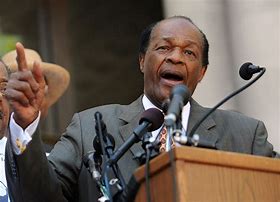
But then he was drawn into the civil rights movement. In the turbulent 1960’s Marion founded the civic organization PRIDE. This organization was on the forefront of the home rule fight that would permit Washington residents to govern themselves, provided job training and placement for citizens, and encouraged black folks to vote at a time when they weren’t sure they could.
So it was, with this type of civil rights leadership, no surprise the Marion Barry would be elected mayor four times and ultimately be proclaimed “Mayor for Life!” He was known for campaigning tirelessly, for getting out the votes and for making a neighborhood’s small issue a priority for the government.
During campaign season he was also known to eat the same meal multiple times with a smile on his face. From coq au vin and champagne in northwest to chitlins and Kool-Aid in southeast within the span of hours, Mayor Barry was comfortable among kings, but more comfortable in the ‘hood!
However, his most lasting legacy may well be the most easily overlooked – but easiest to find. Marion Barry formed the Mayors Summer Youth Employment Program (“MYEP”).
This simple, yet ingenious, move gave countless thousands of teenagers their first jobs – paying them minimum wage to work in government and private sector jobs. As high schoolers flooded out of schools, they were dispersed into office buildings, parks, community centers, and restaurants to continue their education. Instead of academic lessons we learned equally important professional ones. Instead of causing mayhem in the streets, we were sweeping them, or painting the nearby building, or coaching in the adjacent park, or just walking them to the Metro Bus stop on the way to work.
Mayor Barry helped us understand that Benning Road and Georgia Avenue weren’t there to limit us to the neighborhoods that we cherished so much and to appreciate that the streets in our communities were for going places.
Of course, with many participants coming from impoverished homes, these jobs were an economic boost and a source of pride for young people and their families. Each morning a teenager set out on South Dakota Avenue or P Street towards a certain destination with unlimited opportunities as opposed to an uncertain destination with no upside at all.
Importantly, these employed, and now civically engaged, teenagers soon reached voting age. They created a vocal and opinionated political base for Mayor Barry, contributing to the fierce loyalty so many felt towards him for the rest of his life.
Perhaps the most vocal and empowered of these young people participated in an auxiliary program of the MYEP called Mayor Barry’s Youth Leadership Institute (“MBYLI”). For two weeks each summer, student selected to participate in the MBYLI stayed on the campus of Howard University and participated in evening leadership training seminars. These sessions began each night with an enthusiastic chant, now emblazoned on the psyche of each participant:
Hello winners!
Standing in this room…
Are the greatest…
Most committed…
Most responsible group of people…
This world has ever known!
If it is to be…
It is up to me!
Yes I can…
Yes I will!
Yes we can…
Yes we will!
I am…
We are…
The greatest!
Acknowledge yourselves!
and ended each two week session with mock-elections for youth mayor and city council positions. In between, many of us had our first exposure to college life, living with non-family members from a different community, eating cafeteria food that provided options you may not typically have a home, allowing social options beyond the boundaries imposed by parents and being solely responsible for making it to your summer job on time the next morning.
In retrospect, much of this seems pretty fundamental. But to teenagers who lived on the Gold Coast or near the big Chair these experiences opened up a world we’d never known or considered, they represented a faith in our futures and they set an explicit expectation for our contributions. Perhaps most importantly the MYEP and MBYLI established not that we were owed or would be given anything, but that
If it is to be
It is up to me
Marion Barry made some big public missteps. He hurt and disappointed a lot of people. He embarrassed the government, highlighting the hypocrisy of the War on Drugs, while also falling victim to it.
He was also a genius and a hero who fought for the underdog, and provided dignity and opportunity for many more while creating the foundation for Washington to create an economy more diverse and robust than that of a servant’s colony to the federal government.
Marion Barry earned the title Mayor for Life because, by his actions, he demonstrated that
If It Is To Be
It Is Up To Me